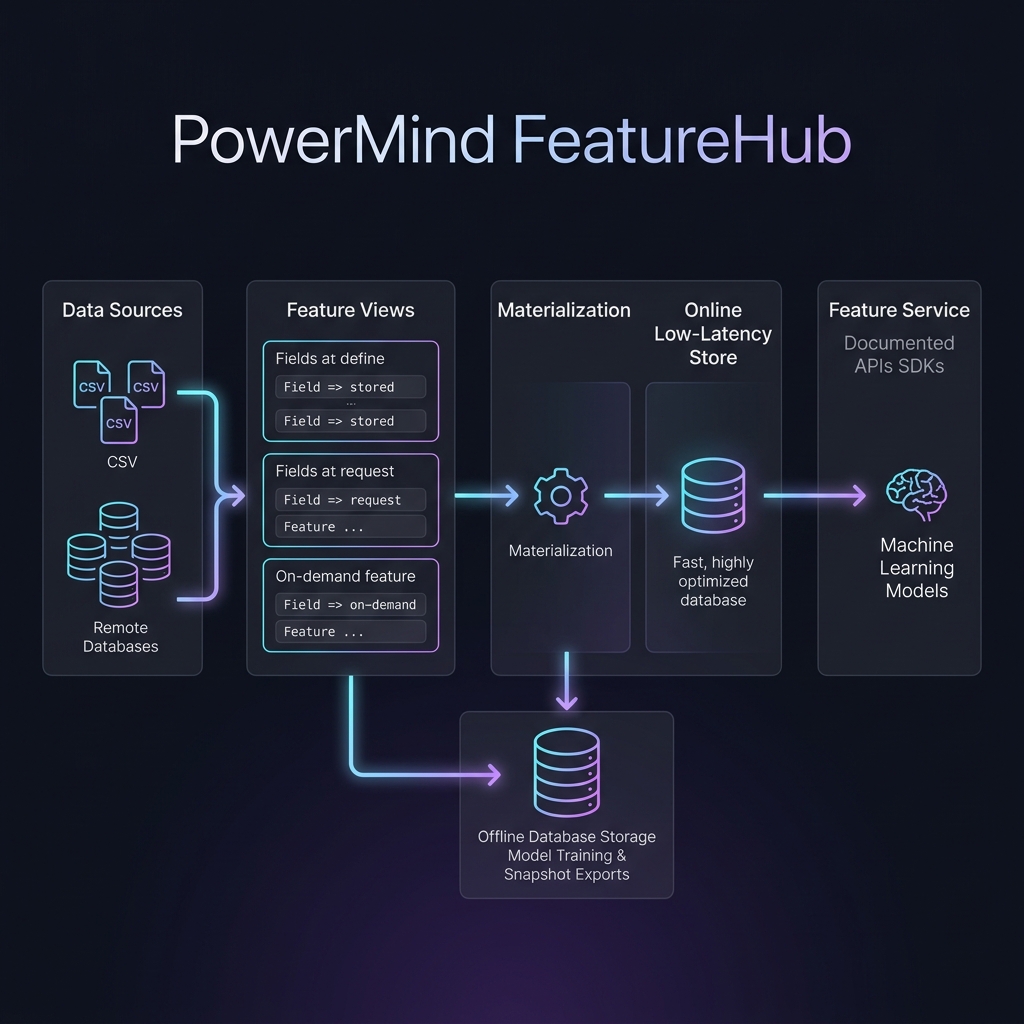
PowerMind FeatureHub Overview
Introduction
FeatureHub is a centralized feature store designed to streamline the lifecycle of machine learning features. It provides a single repository to define, store, share, and serve features for both offline training and real-time online inference.
By separating the feature engineering logic from the model serving layer, FeatureHub ensures that the features used for training models are identical to the features used during real-time predictions.
What Problem Does FeatureHub Solve?
In traditional machine learning workflows, data scientists write feature extraction pipelines for training datasets, while software engineers rewrite the same logic in production serving environments. This approach leads to several critical issues:
- Train-Serve Skew: Differences in implementations or data definitions between training (offline) and serving (online) environments cause models to perform poorly in production.
- Pipeline Redundancy: Multiple teams end up rebuilding the same features (e.g., "user click count in the last 7 days") across different pipelines.
- Serving Latency: Models requiring precomputed historical features must query slow, transactional databases during inference, leading to unacceptable response times.
FeatureHub solves these problems by providing: - Unified Feature Definitions: Define features once, reuse them for training, and serve them online with a single definition. - Consistency Guarantee: Automated workflows ensure that online feature values are kept consistent with offline training snapshots. - Low-Latency Serving: Pre-computed features are synchronized into a high-speed, online low-latency store.
Core Concepts
To understand FeatureHub, it is important to familiarize yourself with these key terms:
- Workspace: A project or tenant boundary. All data sources, feature views, feature services, exports, and integration keys belong to a specific workspace to ensure isolation between teams or environments.
- Datasource: A reference to a raw input dataset or database table. FeatureHub supports CSV file uploads and remote databases.
- Join Key: The unique identifier (e.g.,
customer_id,user_id) used to map and look up features. - Event Timestamp: The timestamp of when an event or row occurred. This is crucial for point-in-time correctness.
- Feature View: A versioned definition of feature columns, data types, and derived expressions built from a registered datasource.
- Stored Feature: A precomputed feature value that can be materialized into the online store for low-latency predictions.
- Feature Service: A stable serving contract that bundles a list of feature references required by a specific model.
- Materialization: The process of loading precomputed features from the offline storage tables into the online, low-latency serving database.
- Export: A downloadable CSV snapshot of the historical features table for offline model training or analyst review.
- Integration Key: A workspace-scoped API key used for external services, automation scripts, and SDK clients to authenticate without requiring standard user logins.
High-Level Data Flow
The following diagram illustrates how raw data sources are registered in FeatureHub, structured using feature views, materialized into a low-latency database for real-time models, and exported for offline model training: